


The tone un crypto improved last week and showing early signs of stabilisation rather than a confirmed trend reversal. In crypto, selling pressure and institutional outflows have eased, but price actions still needs to reclaim important trend levels before the move can be treated as more than a bottoming and accumulation process.
Macro remains volatile. Softer U.S. labour data have weakened the case for an immediate tightening shock, but shifting rate expectations, persistent inflation risks and oil volatility mean the Federal Reserve has not turned decisively dovish. The most supportive outcome for risk assets would be an extended pause followed by a gradual softening in policy expectations.
Equities remain an important transmission channel for crypto. Investors are beginning to question the durability and distribution of returns from AI capital expenditure, with attention potentially shifting from semiconductor suppliers towards hyperscalers and software companies. A broadening or cooling of AI leadership, rather than a collapse, could allow crypto to attract more relative-value capital.
Crypto
BTC’s tactical message did not materially change this week: selling pressure eased, but a durable uptrend has not yet been confirmed. BTC spent much of the week in the low-to-mid $60,000s, briefly trading near $61,335 after Strategy disclosed fresh BTC sales before recovering towards $64,000 by Friday.
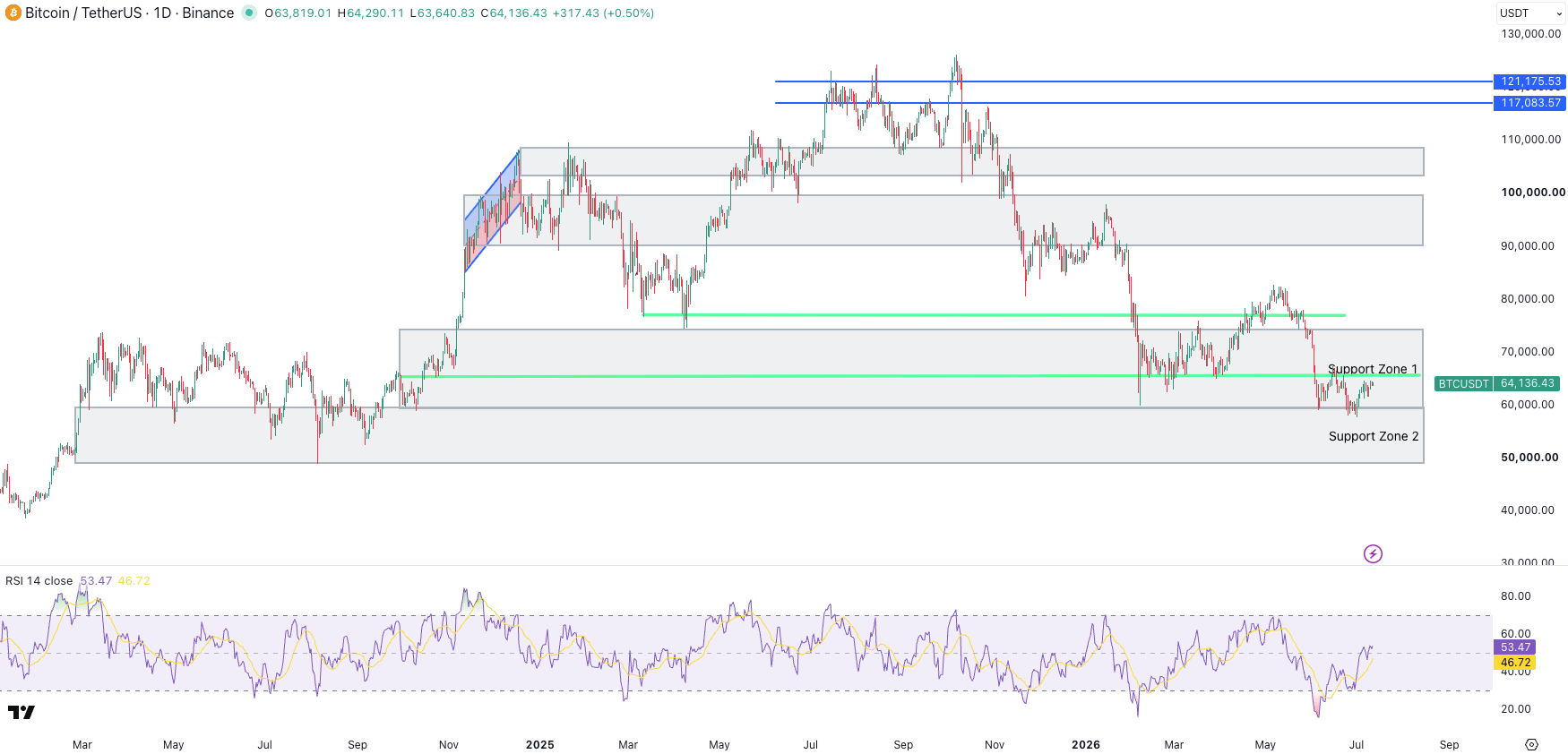
Strategy disclosed that it sold 3,588 BTC for approximately $216m between 29 June and 5 July. The announcement initially revived concerns that one of the market’s most important treasury buyers had become a seller. However, the company indicated that the sales were driven by balance-sheet considerations rather than the start of a broader corporate liquidation. The market therefore treated the disclosure more as the removal of an overhang than as a new systemic threat, although confidence in the crypto-treasury model remains weaker.
The ETF story matters more than the price bounce. The week of 6–10 July produced approximately $197.4m of net inflows after eight consecutive outflows. This is constructive, but the scale remains modest: it is enough to suggest that the bleeding has paused, not enough to conclude that institutional sponsorship has been fully repaired.
A bottom can form while flows are merely becoming less negative, but a new bull leg would normally require consistent and repeatable absorption rather than a single positive week after a prolonged washout.
Positioning and market structure therefore remain more important than excitement. BTC is still a bottoming market rather than a reclaimed trend. The 200-week moving average continues to provide support, while approximately $65.8k is the first meaningful resistance level. The more important trend checkpoint is the 200-day moving average near $73.9k.
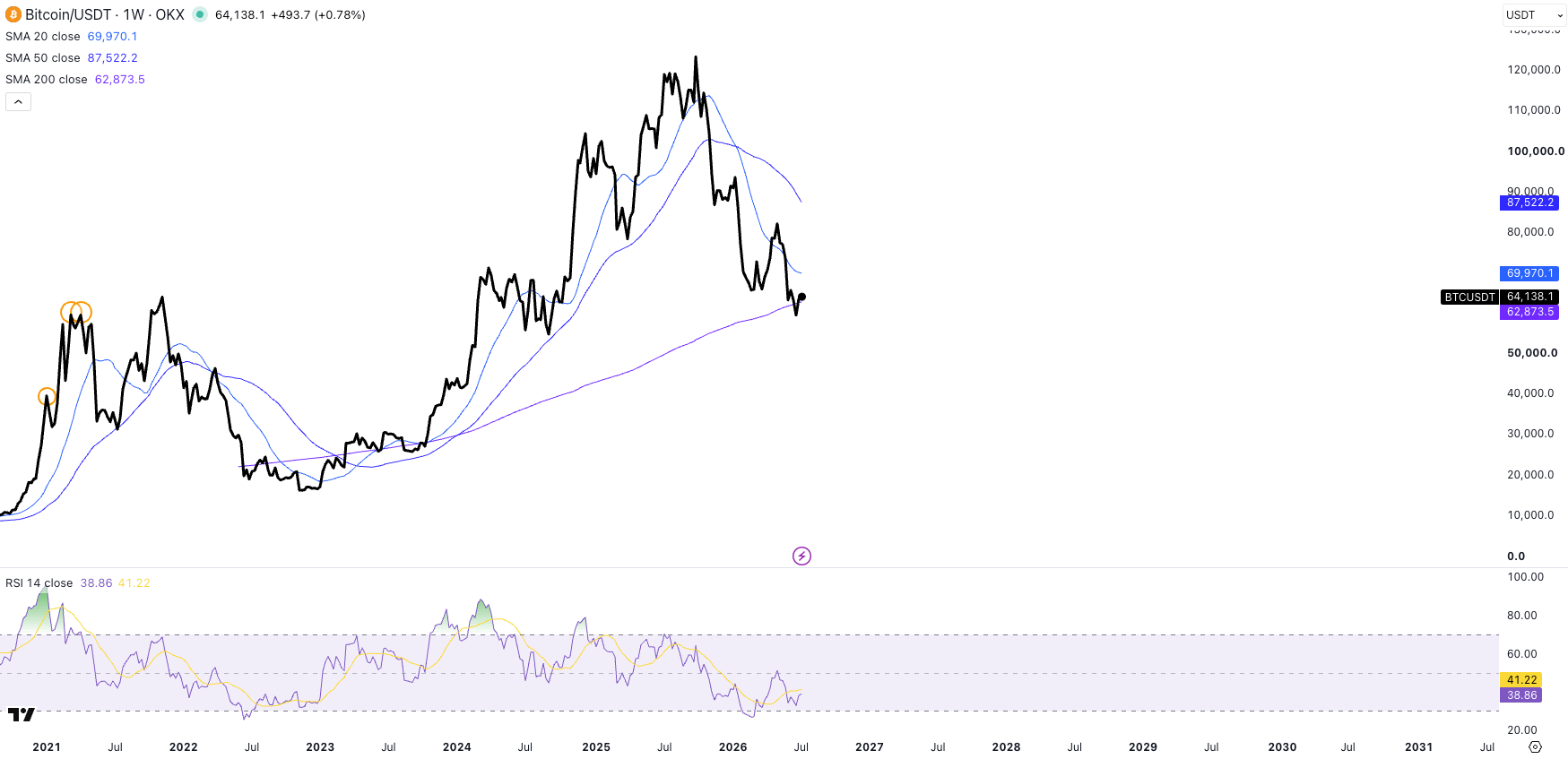
Until BTC reclaims that higher trend line, the better interpretation is that forced selling and panic may be behind us, but the market has not automatically returned to a bull regime. Capitulation appears to have occurred, early accumulation signals are emerging, and the market is now determining how long that phase must continue before markup can begin.
ETH has quietly done the more impressive work. It defended the 1,500 area and outperformed BTC during the week. The weekly performance snapshot shows ETH up 2.0%, BTC up 0.91% and SOL down 4.8%.
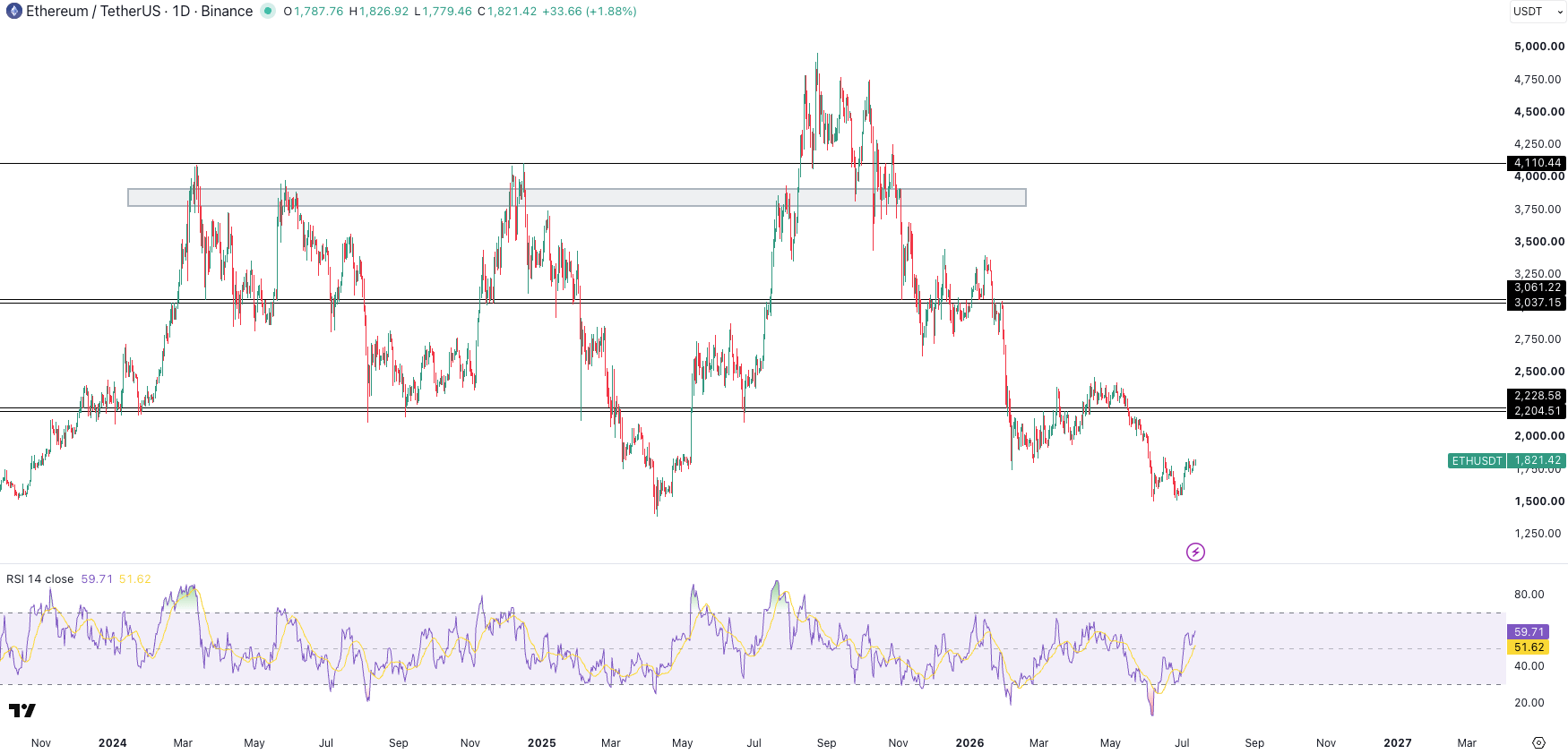
That relative strength matters because better-quality beta will often begin improving before broader altcoin participation follows. SOL, by contrast, remained weaker. The resulting hierarchy is familiar for an early bottoming phase: BTC is trying to stabilise, ETH is attempting to lead, and higher-beta alt exposure remains too early to chase aggressively.
This is the type of price action expected in a low-volatility accumulation zone rather than a clean breakout regime. Support is better defined than it was two weeks ago, but a stronger price response is still needed to confirm that accumulation is transitioning into markup.
Macro
Macro is still the first derivative for crypto. The June U.S. payrolls report showed only 57,000 jobs added, well below expectations, with April and May revised down by a combined 74,000. The unemployment rate dipped to 4.2%, but only because labour-force participation fell to 61.5%, the lowest since March 2021, while wage growth ran at 3.5% year-on-year. In practice, that report reduced the urgency for the Fed to tighten immediately.
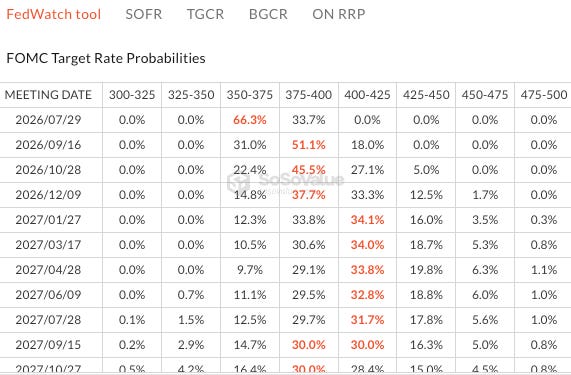
That softer labour pulse has to be weighed against a still-uncomfortable inflation backdrop. The probabilities are implied from 30-day Fed Funds futures, and the June FOMC minutes showed a real split inside the Committee: many participants still saw a case for inflation easing on its own, but many others thought rates might need to move higher if price pressures persisted. Fed’s monetary policy report made clear that AI-related investment, tariffs and conflict-linked energy costs were all being discussed as upside inflation risks. In other words, the Fed is not relaxed. It is conflicted. Market has moved from pricing in 50/50 unchanged/hike in September to 51% for a hike and 18% chance of a 50bp hike.
Oil is the spoiler, but this week it was volatile rather than one-way. Crude began the week under pressure as OPEC+ approved more August supply and traders focused on recovering flows through Hormuz. Mid-week, Brent spiked towards $78–$80 after Trump said the ceasefire with Iran was over and fresh hostilities hit sentiment.
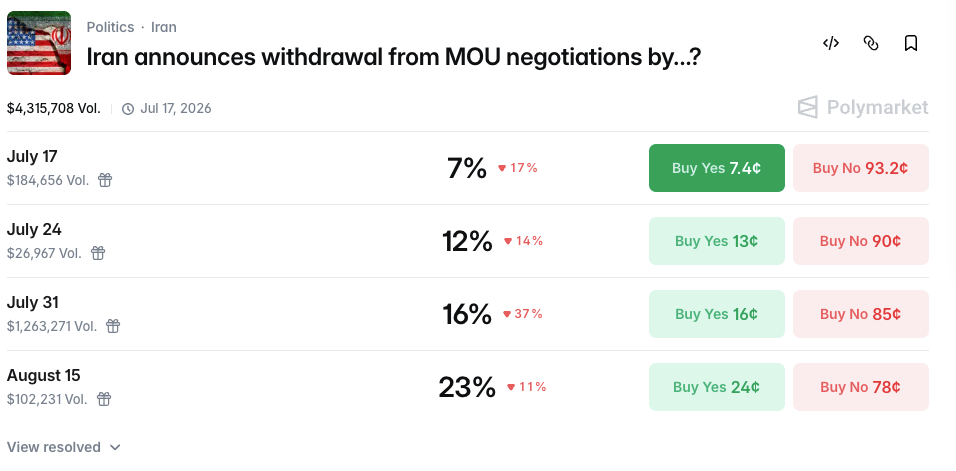
By Sunday, however, Trump was again saying the strait remained open to commercial traffic, while Reuters described Gulf bourses as subdued rather than panicked. The practical implication is that energy remains a source of volatility, but not yet a sustained inflation shock large enough to force the Fed’s hand immediately.
For crypto, that matters. A Fed that faces softer jobs data, a still-tight but not decisively re-accelerating inflation picture, and oil that is no longer relentlessly moving in one direction has more room to lean less hawkish at the margin. That is not the same as imminent cuts. Our view is that if markets correct again and growth data continue to soften, the path of least resistance for the Fed could drift from “threaten hikes” towards “wait, then soften”. That is not a bullish catalyst by itself, but it is consistent with a grinding low-volatility bear-market endgame rather than a new leg lower forced by policy.
Equities and the AI trade
The equity market remains the other key transmission channel. At the start of the week that investors was pivoting from chipmakers to hyperscalers, and separately that hedge funds had sold tech hardware and semiconductor exposure for a fourth straight week.
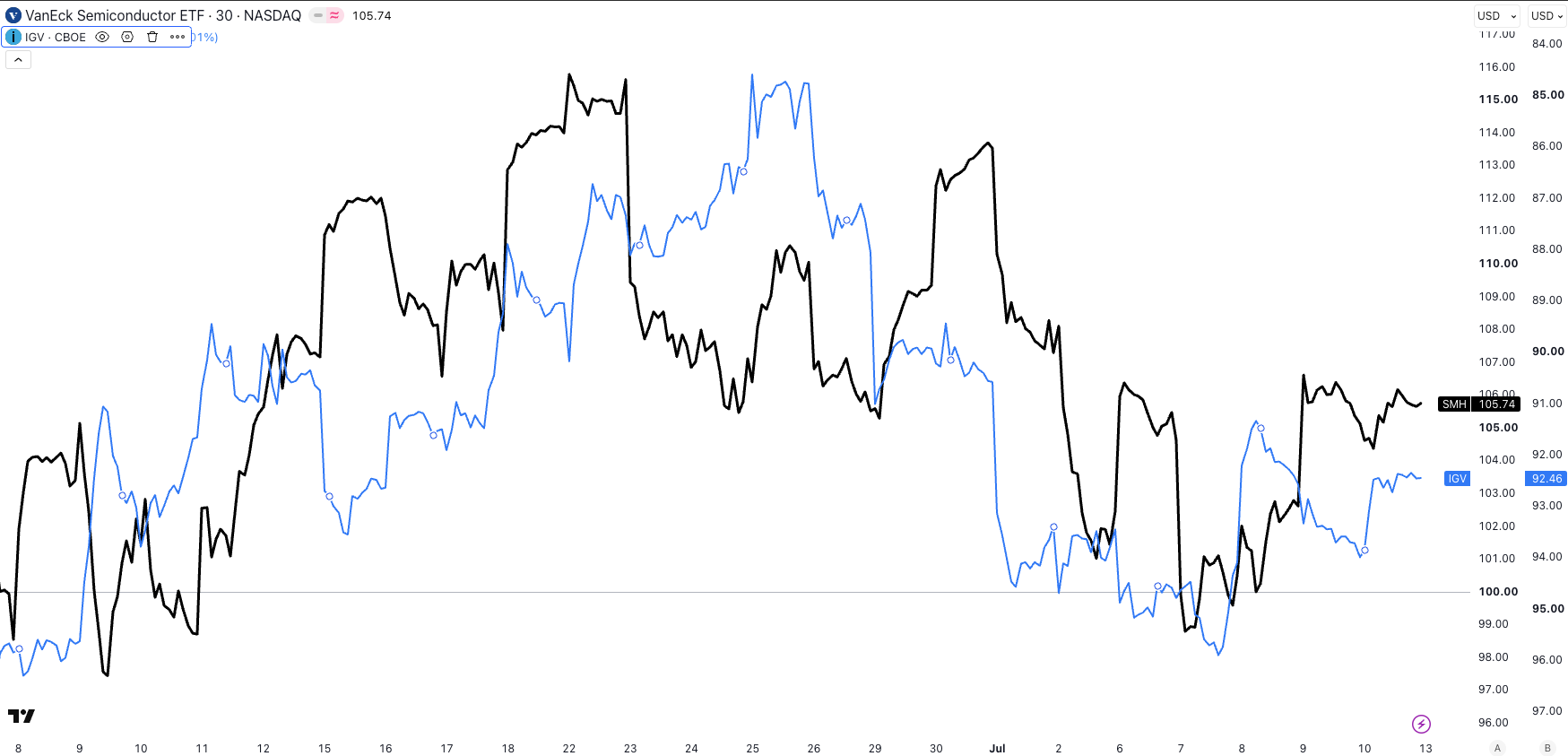
Looking at the IGV [Software ETF] versus SMH [Semiconductor ETF] overlay: software and semis are still moving with an unusually tight inverse relationship, as the market is increasingly debating whether AI capex remains a pure positive for chip suppliers or whether marginal benefit now accrues more to the firms that can monetise the software layer.
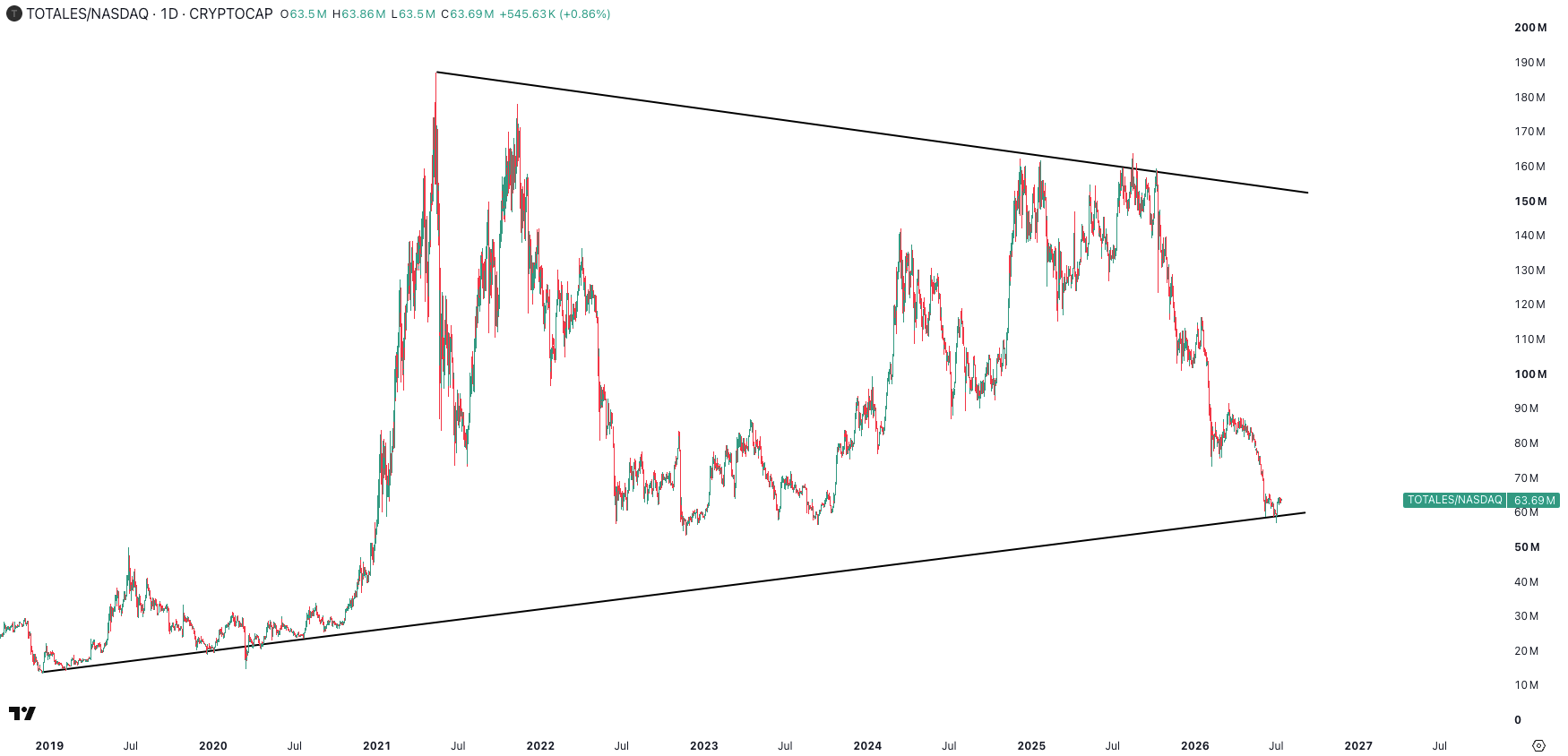
That debate matters for crypto because the TOTALES/Nasdaq ratio only needs AI to stop being the sole destination for risk capital.
The semiconductor index rebounded 2.2% on Monday, even as the broader conversation turned to second-quarter earnings and whether the AI trade can keep justifying itself. The next real test is earnings season, which begins in earnest in late July. Meta remains one of the most important names in that debate because it raised 2026 capex guidance to $125bn–$145bn in April; if management later signals that the slope of spending is flattening, software could outperform while semis de-rate at the margin. A part of our rotation thesis we think can play out in the near future.
Bottom line
The base case in crypto remains the same. The market is showing signs of bottoming, but not enough to declare the bear market over. The most likely path over the next one to two months is low-volatility chop, a gradual accumulation process, and the possibility of one final scare below 60k before a cleaner trend can form. The probability of a move into the low 50s looks low; a sustained break below 50k looks lower still. What would change that view is not simply more bad macro headlines, but a failure of support to hold after ETF flows have already started to stabilise.
The bull case is straightforward. BTC breaks and closes through 65.8k, reclaims the high-60s with authority, and then starts working back towards the 200-day moving average around 73.9k. If that level is reclaimed, the market can start talking about trend repair rather than merely survival. In that scenario, ETH likely continues to lead on a relative basis, and the TOTALES/Nasdaq ratio probably confirms the idea that crypto is beginning to win back risk capital from a more uncertain AI complex.
The bear case is also straightforward. ETF demand fades again after one positive week, oil volatility re-accelerates, the Fed turns more hawkish into August, and BTC loses the 200-week moving average decisively. That would reopen the case for a final liquidation flush. For now, though, the market is not trading that path as the central case. It is trading something more nuanced: fear has eased, accumulation may have started, but price still needs to do the last piece of work.